THE AMERICAN PIANO
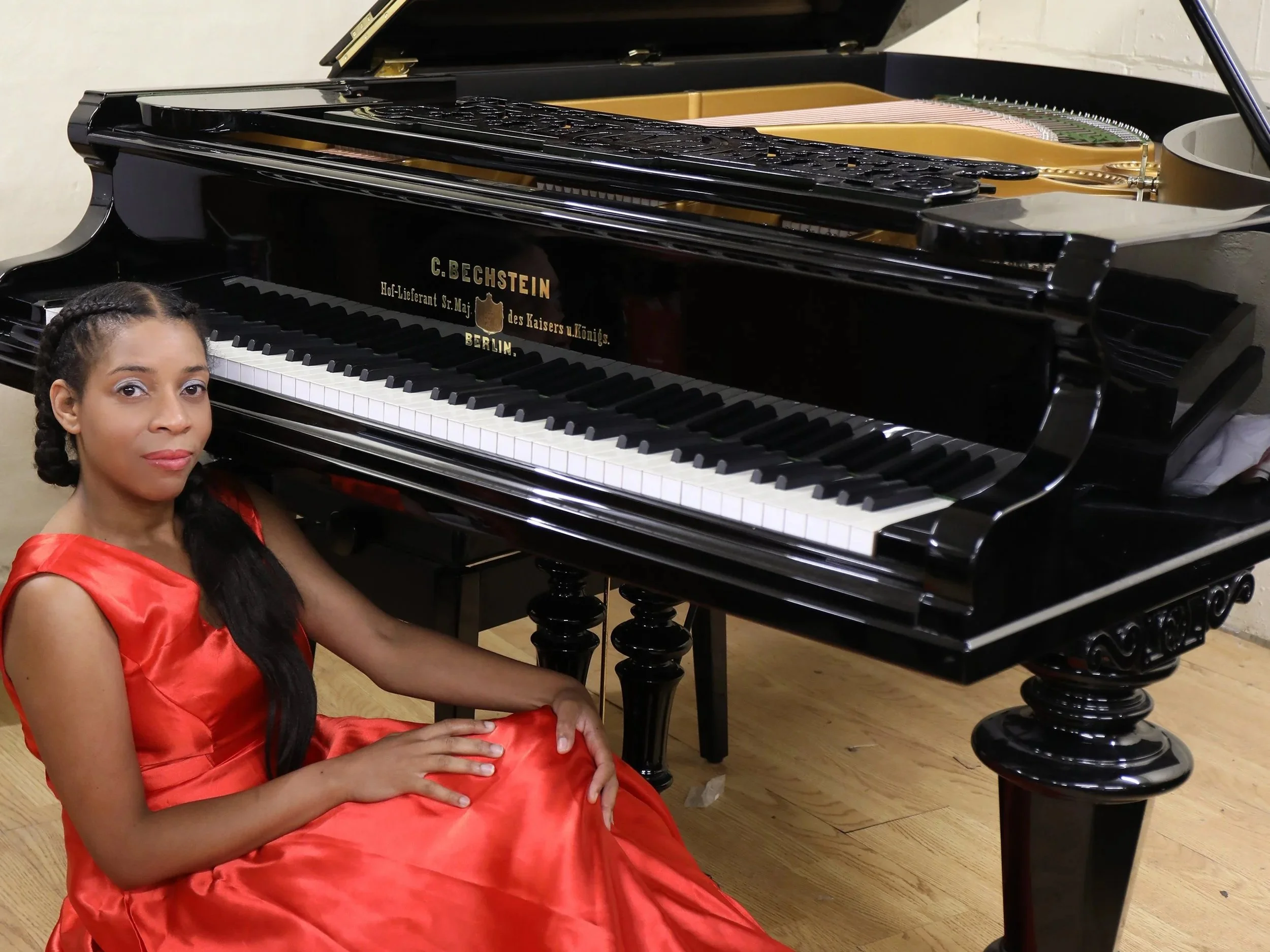
BEATRICE’S American piano concert is full of energizing rhythm, audience surprises and virtuosity Get ready for music by American Indian, African American and European American composers with a mixture of familiar and new classical works for piano.
PROGRAMME
George Gershwin Three Preludes
No.1 in B-Flat Major
No.2 in C-Sharp Minor
-No.3 in E-Flat Major
Lola Perrin The Design
Jelly Roll Morton The Fingerbreaker
Margaret Bonds Valley of Bones
Connor Chee Navajo Vocable No.1
Connor Chee Female Rain
Betty Jackson King Four Seasonal Sketches
I, Spring Intermezzo
II, Summer Interlude
III, Autumn Dance
IV, Winter Holiday
Art Tatum, Arr Jed Distler. Moonglow
________________________________________________
PROGRAMME NOTES
GEORGE GERSHWIN 1898-1937
George Gershwin wrote exciting, timeless music that crossed genres from Broadway, jazz and classical. When Gershwin was asked by contralto Marguerite d’Alvarez to be her accompanist in a series of recitals, she also requested that he compose a solo piano work. He responded with a set of “Three Preludes” for solo piano. Gershwin originally planned to compose 24 preludes and call them “The Melting Pot”. for this group of works. The number was reduced to seven in manuscript form, six in public performance, and further decreased to three when first published in 1926.
LOLA PERRIN b.`1962-
Lola Perrin is a minimalist composer, pianist and climate activist. Her “Design for Solo Piano” is inspired, in part, by climate narratives developed by Paul Allen, a leading researcher with the Centre for Alternative Technology and a key figure in the Zero Carbon Britain project. In his work, Allen explores the deep history and consequences of fossil fuel dependence, including a reflective narrative sometimes referred to as “The Story of Oil.” This account traces how oil has shaped modern industrial civilisation — from its early exploitation to its central role in global systems of energy, economy, and consumption — and raises urgent questions about how such systems might be redesigned in a low-carbon future.
Perrin translates these ideas into musical form not as illustration, but as reflection. “The Design” can be heard as an exploration of structure: how human systems are built, how they evolve, and how they might be re-imagined. The piano writing often unfolds with architectural clarity, suggesting patterns of construction and collapse, repetition and transformation. At times, the music feels mechanical and driven; at others, it opens into more fragile and questioning spaces.
Rather than telling a linear story, the piece invites listeners to consider design as both an aesthetic and ethical force — how the “design” of energy systems, economies, and infrastructures shapes lived experience, and how those designs might be consciously altered in response to the climate crisis.
JELLY ROLL MORTON, 1890 -1941
Roll Morton was an early jazz pioneer who rose to fame in the 1920s as the leader of Jelly Roll Morton's Red Hot Peppers. He was also the first African American jazz musician to play in a mixed group of black and white Americans. The “Fingerbreaker” is a virtuosic piano showpiece designed to test both technique and endurance. With its rapid passagework, syncopated rhythms, and exuberant character, the piece reflects the spirit of early jazz performance culture — where improvisation, showmanship, and rhythmic vitality were central.
MARGARET BONDS 1913-1972
was a child prodigy pianist, composer and student of Florence Price. She wrote over two hundred works, most of which were lost after her death. Bonds is widely known for her classical arrangements of negro spirituals, she brought spirituals into the concert hall with both reverence and bold artistic imagination. The “Spiritual Suite” draws on African American spirituals as sources of structural and expressive material, transforming familiar melodies into richly textured concert works for piano. “Valley of the Bones” from the “Spiritual Suite”| is based on the well known spiritual “Dem Bones”
CONNOR CHEE, b.1987-
First Nations Navajo pianist and composer Connor Chee is recognised for blending his classical piano training with his Native American heritage. He made his Carnegie Hall debut at the age of 12 after winning a gold medal in the World Piano Competition. A graduate of the Eastman School of Music and the University of Cincinnati’s College-Conservatory of Music, Chee’s solo piano writing draws inspiration from traditional Navajo chants and songs.
Female Rain, from his collection “Scenes from Dinétah”, is inspired by the Navajo understanding of rain as a feminine, life-giving force central to the natural world. His set of piano pieces called “Navajo Vocable”, explores the use of vocables — non-lexical syllables used in many Indigenous musical traditions. These sounds carry meaning through rhythm, contour, and cultural context rather than literal translation. In “Navajo Vocable No. 1”, Chee translates this vocal tradition into the language of the piano.
BETTY JACKSON KING 1928-1994
was a singer, pianist, composer and President of America’s National Association of Negro Musicians. Known primarily as a vocal composer, her Seasonal Sketches for solo piano are sublimely lyrical and with jazz influences. King dedicated her “Four Seasonal Sketches” to Dr. Geneva Handy Southall (1925–2004) a pioneering American musicologist known for her scholarly work on African American composers and dedication to preserving Black classical music history. She is best known for her definitive three-volume series on Thomas "Blind Tom" Wiggins, a 19th-century enslaved, self taught, classical prodigy pianist. His slave master hired him out, from the age of eight years to concert promoter Perry Oliver, who toured him extensively in the US, having him perform as often as four times a day. The slave owner and the concert promoter earned today’s equivalent of $1.5 million per year from “Blind Tom’s” performances. “Blind Tom” was never given a cent for his work.
ART TATUM 1890-1956
Tatum was a largely self taught piano prodigy who is known as the greatest jazz pianist of all time. Today his music still remains as the standard by which all mainstream jazz piano is measured by. Originally composed by Will Hudson and Irving Mills, “Moonglow” has become a jazz standard through numerous interpretations, including those of Art Tatum, one of the most influential jazz pianists in history. Tatum’s approach to harmony, rhythm, and improvisation redefined the technical and expressive possibilities of the piano.
Jed Distler’s transcription captures Tatum’s legendary style, preserving the complexity, speed, and harmonic richness of his improvisation. “Moonglow” in this form stands as both tribute and reconstruction — a snapshot of Tatum’s genius filtered through careful transcription, highlighting the intersection of jazz improvisation and written piano tradition.
JED DISTLER b. 1956-
Jed Distler is a NYC based composer, pianist and music critic. He has an expert knowledge of Art Tatum’s style and transcribed Tatum’s main improvisations as a book collection called ‘Jazz Masters’ series. On hearing about Distler’s project Bill Evans also asked Distler to transcribe his improvisations too.
ABOUT BEATRICE

A PIANIST~ RE-WIRING CLASSICAL MUSIC
BEATRICE takes the voltage of the concert grand and drives it beyond the expected grid. A concert pianist with one hand in history and the other on the switch, she re-routes the circuitry of classical music — amplifying unheard voices, fusing classical and jazz, and re-charging the canon for both today’s audiences and a newly connected generation.
Rooted in the rigour of classical training, she performs internationally as both soloist and collaborator at leading venues including Wigmore Hall, Southbank Centre, Kings Place, Snape Maltings and Edinburgh Queen's Hall. Whether performing as a solo artist at 10 Downing Street, in a broadcast on BBC Radio 3 or appearing on the Hollywood Blockbuster ‘The Beekeeper’ she stands at the forefront of a cultural shift within classical music.
BEATRICE’S acclaimed release Black and Classical, throws a spotlight on music by Black women composers and was described by Bandcamp as a “stunning record”. The release led to her invitation to perform at 10 Downing Street in celebration of Black History Month 2025. She is a champion of diversity in classical music and often performs works my black ethnic and First Nation composers in her concerts.
BEATRICE has collaborated with Oram Award–winning electronic improviser Loula Yorke, to create a dialogue between Erik Satie’s piano music and modular synthesis, an analogue resonance meeting live circuitry in real time. She is also the creator and performer of Beatrice the Amazing Astronaut, an interactive outer-space concert adventure for children aged 3–9 and their adults. Through storytelling, movement and live piano performance, she sparks imagination and ignites a first connection to classical music. Performing traditional piano concertos, new and re-imagined works BEATRICE connects traditional classics with modern audiences.
As a composer, BEATRICE has transformed source material into newly powered sound worlds. Psalmus (2021) re-imagines a twelfth-century plainchant as a cinematic meditation for cello and harp. Arrangements for Cello and Piano re-engineers works by Schubert and Brahms into intimate chamber reconstructions.
BEATRICE extends far beyond the traditional concert platform. Her bespoke performances for concert halls, jazz clubs, cultural institutions, theatres and schools alike break spatial expectations to meet audiences where they are.